


Electrical faults are the leading cause of workplace fires in Australia, accounting for approximately 40% of all commercial building fires each year. Most start silently, with no visible warning and no tripped breaker, because the fault was quietly generating heat inside a switchboard or connection that looked perfectly fine from the outside.
Thermal imaging finds those faults before they become emergencies. But in Australia, there are specific standards, qualifications, and reporting requirements that govern how inspections must be conducted and what the results mean for your legal obligations.
What Is Electrical Thermal Imaging?
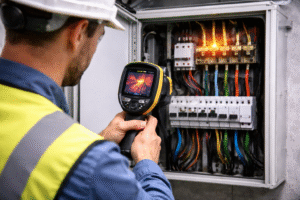
Thermal imaging uses a specialised infrared camera to detect heat signatures invisible to the naked eye. When a connection is loose, a component is failing, or a circuit is overloaded, it generates more heat than it should, and a thermal camera captures that difference as a colour-mapped image.
The technology is non-invasive, meaning inspections run on live equipment without shutting down power. For businesses where downtime is costly, this is a significant advantage over traditional inspection methods.
Why It Matters More Than Most Business Owners Realise?
Safe Work Australia reports that electrical incidents cause an average of 15 worker fatalities and over 300 serious injuries in Australian workplaces each year. Research from the Electrical Safety Office indicates that the majority of electrical fires are preceded by detectable heat anomalies that could have been identified through thermal inspection weeks or months before ignition.
For facility managers, the risk is not just physical. A business that experiences an electrical fire without a history of reasonable inspection activity faces serious exposure under both WHS legislation and property insurance policy terms.
The Australian Standards That Apply
AS/NZS 3000: Wiring Rules The foundational standard for electrical installations in Australia. Any remediation work identified through a thermal inspection must comply with AS/NZS 3000.
AS/NZS 3017: Verification Guidelines Covers verification of electrical installations and establishes documentation requirements for inspection results.
AS/NZS 4836: Safe Working on Live Electrical Equipment Because thermal imaging is conducted on energised equipment, inspectors must comply with this standard, which governs PPE, risk controls, and safe work procedures.
ISO 18436-7: Thermographer Qualifications Establishes three levels of thermographer certification. For commercial electrical inspections, a Level 2 thermographer is the minimum standard required to conduct and interpret results independently.
IEC 60068 and ISO Equipment Standards The cameras used must meet specific calibration and performance standards, with recalibration required within 12 months of the inspection date.
Thermographer Qualifications: What to Look For
Under ISO 18436-7, thermographers are certified at three levels. Level 1 can operate equipment under supervision but cannot produce independent reports. Level 2 is qualified to conduct inspections, analyse results, classify faults, and report independently. Level 3 is the highest qualification, typically involved in developing programs and training others.
Always ask to see current certification from a recognised body before engaging any provider. Confirm they hold an electrical licence or work alongside a licensed electrician, as a thermal report without electrical expertise carries significantly less weight from a compliance and insurance standpoint.
How a Compliant Inspection Works?
Load requirements are critical. Equipment must be running at a minimum of 40% rated load for meaningful results. Your provider should advise you on this in advance and may recommend scheduling during peak operational hours.
The inspection involves the thermographer scanning each component systematically, identifying temperature differentials against baseline readings, and flagging anomalies for assessment. All switchboard doors and distribution boards must be accessible throughout.
Fault classification uses a recognised temperature differential framework. A rise of 1 to 10 degrees above a reference component is a minor anomaly. 11 to 20 degrees is a moderate concern. Above 20 degrees is serious. Above 40 degrees above ambient is critical and may require immediate action.
The report must include inspection date and time, equipment identification, thermal and visual images, temperature measurements, fault classifications, remediation recommendations, and the thermographer’s certification details. This report is a legal document and forms part of your compliance record.
Your Legal Obligations
Australian WHS legislation requires businesses to maintain electrical systems in a safe condition through regular inspection and maintenance appropriate to the risk. While thermal imaging is not mandated by a single specific law, it is widely recognised by regulators in Victoria, Queensland, New South Wales, and Western Australia as best practice for commercial facilities.
Many commercial property insurers now include thermal imaging clauses as a condition of electrical fire cover. If your policy contains such a clause and you have not been conducting compliant inspections, you may face a coverage dispute in the event of a claim.
How Often Should Inspections Be Conducted?
For most commercial facilities, an annual inspection of all main switchboards, distribution boards, and high-load electrical equipment is the minimum recommended frequency. Higher-risk facilities including manufacturing plants, data centres, and healthcare buildings are typically inspected every six months.
An out-of-cycle inspection is advisable after any significant electrical work, following a fault or incident, or after major changes to electrical load.
What Happens After the Inspection
Minor anomalies should be logged and monitored until the next scheduled inspection. Moderate findings should be referred to a licensed electrician for remediation within 30 to 90 days. Serious and critical findings require prompt action, and in some cases equipment should be taken out of service until the fault is rectified.
All remediation work must be documented with a certificate of compliance. Keep inspection reports and remediation records on file for a minimum of five years. These records are your evidence of due diligence and will be essential if a claim or investigation arises.
Choosing the Right Provider
Confirm the thermographer holds a current Level 2 or Level 3 certification from a recognised body. Ask whether they work alongside a licensed electrician. Request a sample report to assess whether documentation meets the required standard. Check equipment calibration records and confirm the camera meets IEC standards. Verify they carry professional indemnity insurance.
A provider who cannot readily answer these questions is not the right choice for a compliance-grade inspection.
Frequently Asked Questions
Is thermal imaging mandatory for commercial properties in Australia?
It is not mandated by a single specific law, but WHS legislation requires electrical maintenance appropriate to the risk. For most commercial facilities, thermal imaging is recognised as best practice and is increasingly expected by regulators and insurers.
Does the power need to be turned off?
No. Thermal imaging is conducted on live, energised equipment. This is one of its key advantages. Your inspector works safely around live systems in compliance with AS/NZS 4836.
How long does an inspection take?
A small premises with a single switchboard typically takes one to two hours. A large facility with multiple distribution boards can take a full day. Your provider should give you an estimate based on a scope of works discussion beforehand.
What should I do if a critical fault is found?
A critical fault requires prompt action and in some cases the equipment should be taken out of service immediately. Your thermographer should flag this verbally before the written report is issued so you can act without waiting for documentation.
Can thermal imaging detect all electrical faults?
It detects heat-related anomalies covering loose connections, overloaded circuits, and failing components. It does not detect faults that have not yet generated a measurable heat signature, which is why it works best as part of a broader electrical maintenance program.
Will my insurer require it?
An increasing number of commercial insurers include thermal imaging clauses in policy terms. Review your policy and speak with your broker to confirm whether it is a condition of your cover.
Can it be used on solar and battery storage systems?
Yes. Thermal imaging identifies hotspots, cell failures, and connection faults in solar arrays, inverters, and battery storage systems. Facility managers with commercial solar assets should factor this into their inspection program.
How do I store inspection records?
Keep all reports, remediation records, and compliance certificates in a secure file, physical or digital, for a minimum of five years and ideally for the life of the tenancy or building.
How do I know if a report is compliant?
A compliant report includes inspection date and time, equipment identification, thermal and visual images, temperature measurements, severity classifications, remediation recommendations, and the thermographer’s certification details. If any element is missing, the report does not meet the standard.
Work With a Provider You Can Trust
ASJ Electrical Solutions is a specialist electrical services provider delivering thermal imaging inspections that meet the full requirements of Australian standards. Their team combines licensed electricians and certified thermographers to cover everything from pre-inspection load planning through to compliant reporting and remediation.
Every inspection is conducted by certified personnel, documented to a compliant standard, and backed by the full scope of electrical services needed to act on findings without engaging a second provider.