

Electrical testing is one of the most misunderstood areas of workplace safety compliance in Australia. Many businesses know they are required to do it, but far fewer understand exactly which tests are mandatory, what each test is actually checking, which standard governs it, and how often it needs to be done.
The answer is not the same for every situation. The mandatory electrical tests that apply to a factory are different from those that apply to a new residential installation or a rental property. The tests required under the Work Health and Safety Regulation 2017 (Cth) overlap with, but are not identical to, those required under AS/NZS 3000:2018 (the Wiring Rules) or AS/NZS 3760:2022 (the in-service testing standard).
This article sets out the five electrical tests that are most consistently required across Australian workplaces and electrical installations, explains what each test measures, references the applicable standard or regulation, and clarifies who is authorised to carry it out. Where our electrical safety inspection services are relevant to a test, we note that connection clearly.
Important note: All electrical testing in Australia must be carried out by a licensed electrical worker (LEW) or, for specific test-and-tag work, a person who holds a recognised AS/NZS 3760:2022 competency. State and territory licensing requirements vary slightly. If you are unsure who can legally conduct a specific test in your state, contact your state electrical safety regulator.
The 5 Mandatory Electrical Tests in Australia
The following five tests are mandated either explicitly by legislation or by the standards referenced in legislation. Together they form the core of electrical compliance testing for both fixed installations and in-service portable equipment.
Test 1: Continuity of the Protective Earth Conductor
The continuity test verifies that the earth conductor connecting a piece of electrical equipment or an installation back to the main earth is intact and has sufficiently low resistance. It is the most fundamental safety test in any electrical testing sequence because a broken or high-resistance earth path means that a fault current has no safe return route, leaving exposed metal parts at dangerous voltages.
What it checks
The test measures the resistance of the earth path from the earth pin of a plug (or the earth terminal of a fixed installation point) through the protective earth conductor back to the source earth. A high reading indicates a broken, corroded, or incorrectly terminated earth connection.
Pass criteria
For portable equipment tested under AS/NZS 3760:2022, the earth continuity resistance must be less than or equal to 1 ohm (including the resistance of the test leads). For fixed installations tested under AS/NZS 3000:2018 clause 8.3.3, the earth fault loop impedance of each circuit must be low enough to ensure the overcurrent protective device will operate within the required disconnection time specified in Table 9.3 of the standard.
When it is required
- New or altered fixed installations: Required before energisation under AS/NZS 3000:2018 cl. 8.3.3
- Portable equipment in workplaces: Required at each test-and-tag inspection under AS/NZS 3760:2022 cl. 5.3
- After any repair involving the earth conductor: Required before return to service
- Hostile workplace environments (factories, construction, food processing): Every 6 months under AS/NZS 3760:2022 Table 4
Who can perform it
For portable equipment, a person holding a current AS/NZS 3760:2022 competency (test-and-tag accreditation) can perform this test. For fixed installations, a licensed electrical worker is required.
| Detail | Value / Standard | Pass Criterion | Frequency |
|---|---|---|---|
| Governing standard | AS/NZS 3760:2022 (portable); AS/NZS 3000:2018 cl. 8.3.3 (fixed) | Pass: less than or equal to 1 ohm (portable) | 6 months (hostile); 12 months (normal) for portable |
| Equipment scope | All Class I (earthed) portable equipment; all fixed installation circuits | Earth fault loop impedance within Table 9.3 limits (fixed) | Before energisation for new/altered fixed work |
Test 2: Insulation Resistance Test
The insulation resistance test measures the resistance of the insulation surrounding electrical conductors. Healthy insulation has very high resistance (in the megohm range), which keeps current safely contained within the conductor. Degraded insulation, caused by age, heat, moisture, mechanical damage, or chemical contamination, allows leakage current to flow, creating shock risk and fire risk.
What it checks
A direct current test voltage is applied between the active/neutral conductors and the earth conductor (or between conductors). The resulting resistance reading indicates the condition of the insulation. A low reading signals that insulation integrity has been compromised.
Test voltage and pass criteria
Under AS/NZS 3760:2022, portable equipment is tested at a DC test voltage of 500V DC. The minimum acceptable insulation resistance is 1 megohm for Class I equipment and 2 megohms for Class II (double insulated) equipment.
For fixed installations under AS/NZS 3000:2018 clause 8.3.2, the minimum insulation resistance between any two active conductors and between each active conductor and earth is 1 megohm for installations up to 500V, tested at 500V DC.
When it is required
- New or altered fixed installations: Required before energisation under AS/NZS 3000:2018 cl. 8.3.2
- Portable equipment in workplaces: Required at each test-and-tag inspection under AS/NZS 3760:2022 cl. 5.2
- After immersion or exposure to moisture: Required before return to service regardless of scheduled interval
- After mechanical damage to cabling or equipment: Required before return to service
Who can perform it
For portable equipment, a person with AS/NZS 3760:2022 test-and-tag accreditation can carry out this test. For fixed installation wiring, a licensed electrical worker is required. The test must not be applied to equipment containing voltage-sensitive components (such as surge protectors or electronic speed controllers) without first following the equipment manufacturer’s isolation procedures.
| Detail | Value / Standard | Pass Criterion | Frequency |
|---|---|---|---|
| Governing standard | AS/NZS 3760:2022 cl. 5.2 (portable); AS/NZS 3000:2018 cl. 8.3.2 (fixed) | Pass: at least 1 megohm (Class I); at least 2 megohms (Class II) | 6 months (hostile); 12 months (normal environment) for portable |
| Test voltage | 500V DC (standard for up to 500V installations and equipment) | Higher resistance is better; readings below pass threshold require immediate action | Before energisation for new or altered fixed installations |
Test 3: Polarity Verification
The polarity test confirms that active, neutral, and earth conductors have been correctly connected throughout a fixed installation. Reversed polarity, where the active and neutral conductors are transposed at a socket outlet or fitting, is a wiring error that creates shock risk even when a switch is in the off position, because the active conductor remains energised at the load-side terminal.
What it checks
The test verifies that the active conductor is connected to the active terminal, the neutral to the neutral terminal, and the earth to the earth terminal at every point in the installation. It also confirms that single-pole switching devices are installed in the active conductor only, not in the neutral.
Pass criteria
Under AS/NZS 3000:2018 clause 8.3.4, polarity must be verified for every circuit in a new or altered installation. There is no numerical pass threshold. The test is a verification check: every outlet, fitting, and connection must have correct polarity. A single transposed connection constitutes a fail.
When it is required
- New fixed installations: Required as part of verification before energisation under AS/NZS 3000:2018 cl. 8.3.4
- Altered or extended installations: Required for the altered circuits before return to service
- After any wiring repair or connection work: Required before re-energisation
Note: Polarity testing is required for fixed installations under AS/NZS 3000:2018. It is not a test that applies to portable equipment under AS/NZS 3760:2022, as the polarity of a portable appliance plug is fixed by its design. Polarity testing in the context of portable equipment is effectively covered by the earth continuity and insulation resistance tests.
Who can perform it
Polarity verification of fixed installations must be carried out by a licensed electrical worker. It requires access to the energised or de-energised installation and the use of appropriate test instruments.
| Detail | Value / Standard | Pass Criterion | Frequency |
|---|---|---|---|
| Governing standard | AS/NZS 3000:2018 cl. 8.3.4 | Pass: correct polarity at every outlet and connection point in the circuit | Before energisation of new or altered circuits |
| Applies to | All new and altered fixed electrical installations | Single-pole switching in active conductor only; correct terminal connections throughout | After any repair or extension involving wiring connections |
Test 4: RCD Operating Time Test (Residual Current Device Testing)
Residual Current Devices (RCDs) are the primary protection against electric shock in Australian electrical installations and workplaces. An RCD monitors the difference in current between the active and neutral conductors: when a fault current flows to earth (such as through a person’s body), that imbalance causes the RCD to trip within milliseconds, cutting the supply before a fatal dose of current can be delivered.
RCD testing is explicitly mandated under clause 156 and 157 of the WHS Regulation 2017 for workplace electrical equipment and installations. It is also required for new fixed installations under AS/NZS 3000:2018 clause 8.3.6 and for portable RCDs under AS/NZS 3760:2022.
What it checks
An RCD tester injects a precisely controlled fault current into the circuit and measures the time the RCD takes to trip. The test is performed at the RCD’s rated residual operating current (Ian), typically 30 mA for personal protection RCDs, and may also be performed at 5 x Ian for a higher-current trip test.
Pass criteria
Under AS/NZS 3000:2018 clause 8.3.6 and AS/NZS 3760:2022, an RCD rated at 30 mA must trip within 300 milliseconds when tested at its rated current. For RCDs used in higher-risk environments or for specific protection applications, faster trip times may be required by the relevant equipment standard.
Push-button test vs instrument test
There are two types of RCD test that are both required:
- Push-button functional test: Confirms the RCD’s mechanical trip function operates. Required every 6 months under WHS Regulation 2017 clause 157. Can be performed by any competent person. Does not measure trip time or trip current.
- Instrument test (RCD tester): Measures actual trip time in milliseconds at rated current. Required as part of formal testing under AS/NZS 3017:2022 (fixed installations) and AS/NZS 3760:2022 (portable equipment and plug-in RCDs). Must be carried out by a licensed electrical worker or a competent test-and-tag technician for portable RCDs.
When it is required
- New fixed installations: Before energisation under AS/NZS 3000:2018 cl. 8.3.6
- Push-button test in workplaces: Every 6 months under WHS Regulation 2017 cl. 157
- Instrument test of fixed RCDs: Annually as part of formal electrical inspection
- Portable RCDs (safety adaptors): Every 6 months for push-button test; annual instrument test under AS/NZS 3760:2022
Who can perform it
The 6-monthly push-button test can be conducted by any competent person who understands the procedure. The formal instrument test of fixed RCDs requires a licensed electrical worker. Instrument testing of portable RCDs can be carried out by a person with AS/NZS 3760:2022 test-and-tag accreditation.
| Detail | Value / Standard | Pass Criterion | Frequency |
|---|---|---|---|
| Governing standard | WHS Reg 2017 cl. 156-157; AS/NZS 3000:2018 cl. 8.3.6; AS/NZS 3760:2022 | Pass: trip within 300 ms at rated residual current (30 mA for standard RCDs) | Push-button: every 6 months. Instrument test: annually for fixed |
| Applies to | All RCDs in workplaces; all RCDs in new/altered fixed installations; portable RCDs | RCD must not fail to trip. A failed push-button test is a Critical finding | Portable RCDs: 6-month push-button + annual instrument test |
Test 5: Earth Fault Loop Impedance Test
The earth fault loop impedance (EFLI) test measures the total impedance of the path a fault current would travel if an active conductor came into contact with an earthed metal part. This path runs from the point of fault, through the protective earth conductor, back to the supply transformer, and through the supply conductors back to the fault point.
The lower the earth fault loop impedance, the higher the fault current will be, and the faster the overcurrent protective device (circuit breaker or fuse) will operate to disconnect the supply. If the impedance is too high, the fault current may be insufficient to operate the protective device within the required disconnection time, leaving exposed metalwork at a hazardous voltage for dangerously long periods.
What it checks
The EFLI test measures the actual impedance of the complete fault loop for each circuit in an installation. The result is compared against the maximum permissible loop impedance for the type and rating of the overcurrent device protecting that circuit, as specified in the tables of AS/NZS 3000:2018.
Pass criteria
Under AS/NZS 3000:2018 Chapter 9 and the associated tables, the measured earth fault loop impedance must be low enough to ensure disconnection within:
- 0.4 seconds for final circuits up to 32A in TN-C-S systems (the standard Australian supply arrangement)
- 5 seconds for distribution circuits
- Faster disconnection times apply in locations of increased shock risk such as bathrooms, swimming pool areas, and construction sites
The maximum allowable EFLI is calculated based on the rated current and operating characteristics of the circuit breaker or fuse. For example, a 20A Type C MCB protecting a 2.5mm2 circuit has a maximum permissible loop impedance of approximately 2.3 ohms at 230V nominal supply voltage.
Why this test is separate from earth continuity
Earth continuity testing (Test 1 above) measures the resistance of the protective conductor alone. EFLI testing measures the resistance of the entire fault loop, including the supply conductors back to the transformer. A circuit can pass the continuity test but fail EFLI if the supply conductors are long, undersized, or have high impedance due to poor connections at intermediate points. Both tests are required because they check different things.
When it is required
- New fixed installations: Required before energisation under AS/NZS 3000:2018 cl. 8.3.3
- Altered circuits: Required for altered circuits after any change affecting circuit length, conductor size, or protective device rating
- Formal electrical safety audits: Recommended as part of a comprehensive electrical safety inspection in accordance with AS/NZS 3017:2022
- After rewiring or major panel upgrades: Required before re-energisation
Who can perform it
EFLI testing of fixed installations must be carried out by a licensed electrical worker using a calibrated loop impedance tester. It is not part of portable appliance testing under AS/NZS 3760:2022, as it applies to fixed wiring only.
| Detail | Value / Standard | Pass Criterion | Frequency |
|---|---|---|---|
| Governing standard | AS/NZS 3000:2018 cl. 8.3.3 and Chapter 9; AS/NZS 3017:2022 | Pass: measured EFLI below maximum permissible value for the protective device rating | Before energisation of new or altered circuits; periodic audit for existing installations |
| Applies to | All fixed electrical installation circuits | Disconnection time within limits of AS/NZS 3000:2018 Table 9.3 (0.4s for final circuits) | Included in any formal electrical installation verification under AS/NZS 3017:2022 |
Other Tests You May Encounter: What They Are and When They Apply
The five tests above are the core mandatory tests, but you may encounter others during a comprehensive electrical safety inspection. Understanding what these are and why they are conducted helps you ask the right questions of your electrical contractor.
Visual inspection
Technically a check rather than an electrical test, visual inspection is the first step in any testing sequence under both AS/NZS 3000:2018 and AS/NZS 3760:2022. It identifies damage, incorrect installation, incorrect cable management, missing guards, or obvious defects before instruments are connected. Visual inspection findings often prevent unnecessary testing time and identify safety hazards that a meter cannot detect.
Phase rotation test
For three-phase installations, a phase rotation test confirms that the phase sequence is correct before three-phase motors and equipment are connected. Incorrect phase rotation causes three-phase motors to run in the wrong direction, which can cause mechanical damage and safety hazards. This test is required for any new or altered three-phase installation under AS/NZS 3000:2018.
Functional testing of safety circuits
Emergency stops, safety interlocks, and isolation devices are subject to functional testing requirements under the plant provisions of the WHS Regulation 2017 (Part 5.1) and the relevant machinery safety standards (AS 62061:2014, AS 4024 series). These tests verify that safety circuits operate correctly and that a fault in a safety-related control system will place the machine in a safe state.
Thermal imaging of electrical installations
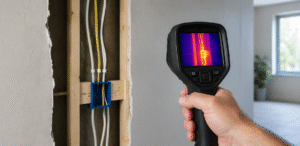
While not a traditional electrical test, thermal imaging is increasingly required by insurers and is referenced as a best-practice inspection measure in Australian WHS guidance. It operates under AS ISO 18434-1:2023 and identifies heat anomalies in switchboards, distribution boards, and connections that would not be detected by any of the five tests above. Our thermal imaging services are conducted by AINDT Level II certified thermographers and produce AS ISO 18434-1:2023 compliant reports.
Testing Intervals at a Glance
The following summarises the required testing intervals for the most common scenarios in Australian workplaces and properties.
Fixed installation verification (AS/NZS 3000:2018 and AS/NZS 3017:2022)
- New installation: full verification (Tests 1 to 5) before energisation
- Altered or repaired circuits: verification of altered circuits before re-energisation
- Existing installations: periodic verification recommended every 5 years for commercial and industrial, and after any major fault or incident
Portable equipment test and tag (AS/NZS 3760:2022)
- Hostile environments (factories, construction, food processing): every 6 months for Class I equipment and extension leads
- Hostile environments (Class II, double insulated): every 12 months
- Normal environments (offices, retail): every 12 months for Class I; every 24 months for Class II
- Hire equipment before each hire: required regardless of environment under AS/NZS 3760:2022
RCD testing (WHS Regulation 2017 cl. 157)
- Push-button functional test: every 6 months in all workplaces
- Instrument test: annually for fixed RCDs; as above for portable RCDs under AS/NZS 3760:2022
Frequently Asked Questions
Are all 5 tests required for every piece of electrical equipment?
No. The tests that apply depend on whether the equipment is portable or fixed, and on the context of the testing. Earth continuity and insulation resistance are required for portable equipment under AS/NZS 3760:2022. Polarity, EFLI, and RCD tests are required for fixed installations under AS/NZS 3000:2018. All five apply to a comprehensive fixed installation verification.
Can I do the tests myself, or does it have to be a licensed electrician?
For portable equipment test and tag, a person holding a recognised AS/NZS 3760:2022 competency can carry out the required tests. This does not require an electrician’s licence. For fixed installation testing (polarity, EFLI, insulation resistance of wiring), a licensed electrical worker is required in all Australian states and territories.
How long do I need to keep test records?
Under the WHS Regulation 2017, records must be kept and available for inspection by a WHS inspector. Safe Work Australia recommends a minimum of 5 years. Some state regulators and insurers require longer retention periods. When in doubt, keep records for the life of the equipment.
What happens if equipment fails a test?
Equipment that fails any mandatory test must be taken out of service immediately and tagged with a ‘Failed’ tag under AS/NZS 3760:2022. It must not be used until it has been repaired by a qualified person and retested. For fixed installations, the failed circuit must be isolated until the fault is rectified and re-verification confirms it is safe.
The Bottom Line
The five mandatory electrical tests in Australia cover the core safety properties of any electrical installation or piece of equipment: the integrity of the protective earth, the condition of insulation, the correctness of wiring connections, the functioning of shock protection devices, and the adequacy of the fault current path. Together they form the testing backbone of both the Wiring Rules and the WHS Regulation.
Knowing which tests apply to your situation, who is authorised to conduct them, and how often they are required is the starting point for building a compliant electrical safety programme. If you would like to understand what your specific obligations are, or if you are due for a formal inspection, our team can help you work through it.
For broader electrical risk management, our energy optimisation services combine safety compliance with efficiency improvements, addressing both risk and cost in the one programme.
Need a certified electrical inspection or compliance test?
Talk to our licensed team today. View our electrical safety inspection services