
Thermal cameras are more accessible than ever. You can hire one for as little as $150 a day, and on the surface, that sounds like a reasonable way to check your electrical installation without the cost of bringing in a specialist. But is it actually the right call for your situation, or does hiring a certified professional deliver something a rental camera simply cannot?
That is the question this guide answers honestly. We look at both options without bias: the real cost of each, what Australian compliance law requires, what a professional does beyond pointing a camera, and the specific situations where each approach genuinely makes sense. By the end, you will have a clear picture of which option fits your needs, and why the answer is not always the same for everyone.
Our thermal imaging services are built around Australian compliance standards, but this guide is designed to help you make an informed decision, not just sell you on hiring us.
1. What Is Electrical Thermal Imaging, and Why Does It Matter?
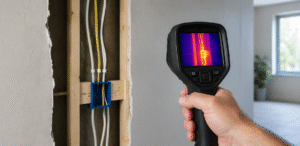
Thermal imaging, or thermographic inspection, uses infrared cameras to detect heat anomalies in electrical systems. Loose connections, overloaded circuits, failing switchgear, and undersized cabling all generate excess heat before they fail visibly. A thermal survey finds these faults non-invasively, and when done properly, before they cause fires, equipment damage, or electrocution.
In Australia, thermal imaging sits at the intersection of electrical safety law, insurance compliance, and preventive maintenance. It is referenced in AS ISO 18434-1:2023 (Condition monitoring and diagnostics of machines, Thermography) and underpins compliance with the Work Health and Safety Act 2011 (Cth) and its state and territory equivalents. Done correctly by a licensed, certified professional, it is one of the best risk-reduction investments available. Done incorrectly, it can create a false sense of security, and potential legal exposure.
Understanding that distinction is the whole point of this comparison.
2. The Real Cost Comparison: Camera Hire vs Professional Survey
Let us start with the numbers, because the sticker price difference is real and worth acknowledging.
Renting a thermal camera (DIY)
- Entry-level rental (FLIR C3, Seek Compact): $150–$250/day
- Mid-range rental (FLIR E5–E8 series): $300–$500/day
- High-resolution rental (FLIR T-series, 320×240+): $500–$900/day
- Weekend hire packages: typically 1.5–2× the daily rate
- Bond / damage waiver: $200–$500 extra
On a pure hardware basis, a $200 camera hire is cheaper than a professional survey. That is a straightforward fact. The more important question is what you get for each option, and whether the cheaper one actually delivers what you need.
Hiring a certified thermal imaging professional
- Single residential switchboard inspection: $300–$500
- Commercial/industrial electrical survey (up to 4 hours on-site): $500–$1,200
- Full-site survey with written compliance report: $800–$2,500+
- Included: certified equipment, licensed operator, AS ISO 18434-1 compliant report, severity classification, remediation recommendations
💡 Worth knowing: The camera itself accounts for roughly 20% of the value in a professional thermal survey. The other 80% is the trained interpretation, correct calibration, structured methodology, and the legally accountable report that comes with a certified operator. That is not marketing, it is the practical reality of what the standard requires.
3. The Certification Gap: Why an Uncertified Scan May Not Be Enough
Under AS ISO 18434-1:2023 and the Work Health and Safety Act 2011 (Cth), a thermographic inspection report is only considered compliant when it is performed by a competent person, defined as someone with the knowledge, skills, and experience to carry out the task safely and correctly.
In practice, this means a certified thermographer holding at minimum an AINDT (Australian Institute for Non-Destructive Testing) Level II Infrared Thermography certification, or equivalent ASNT certification. These certifications require documented field experience, formal coursework, and written examinations covering emissivity, thermal bridging, reflection errors, and report interpretation. They exist because interpreting infrared data incorrectly is genuinely dangerous, missed faults and false positives both carry real consequences.
An uncertified scan submitted to an insurer or safety regulator as evidence of due diligence will not be accepted. And if a fault is missed and a fire or injury results, the absence of certified inspection documentation significantly increases your legal exposure as a PCBU.
Compliance note: Safe Work Australia and state equivalents have prosecuted businesses for inadequate electrical maintenance. Documenting that an inspection was carried out is important, but the documentation must be from a certified operator, reference the applicable standard, and show that findings were actioned. A rental receipt and a set of photos do not satisfy that requirement.
4. What a Professional Thermographer Does Beyond the Camera
This is the section that matters most for understanding the practical difference. A rental camera gives you the same hardware a professional uses, but hardware is only part of the picture. Here is what a certified thermographer brings to an inspection that cannot be replicated by hiring equipment:
- Correct emissivity settings: Each material has a different emissivity value. Copper busbars, painted enclosures, and plastic conduit all behave differently in infrared. Setting the wrong emissivity produces inaccurate temperature readings, the camera will not warn you when this happens.
- Distance-to-spot ratio compliance: Every camera has a minimum measurement distance to achieve accurate spot temperature readings. Operating outside this ratio at an electrical panel produces unreliable data.
- Reflected apparent temperature (RAT) correction: Hot lights, windows, adjacent equipment, and reflective surfaces create false hot spots. An untrained operator will not recognise these as artefacts, a certified thermographer will.
- Load verification: Per AS ISO 18434-1, electrical thermal surveys should be conducted at ≥40% of rated load to produce meaningful results. A professional confirms and documents load conditions before scanning.
- Severity classification against ΔT thresholds: The temperature rise above ambient (ΔT) determines urgency. A professional classifies each finding, Critical, High, Medium, or Low, with recommended action timeframes.
- A compliant written report: AS ISO 18434-1 specifies what a thermographic report must contain. Side-by-side thermal and visual images, emissivity settings, ambient conditions, ΔT measurements, severity ratings, and the thermographer’s certification details.
- Ongoing trend analysis: A professional maintains inspection records across visits. This allows temperature trends to be tracked over time, something a one-off scan, however well conducted, cannot provide.
Our certified team at ASJ Electrical Solutions follows a structured inspection methodology on every survey, not just a visual walkthrough with a camera.
5. Common Mistakes When Using a Hired Thermal Camera
If you are considering a DIY thermal survey, these are the technical pitfalls that most commonly affect results. Being aware of them does not make a rental impossible, but it does illustrate why the skill gap between operating a camera and conducting a compliant inspection is wider than it first appears.
- Scanning at low load: Australian commercial buildings often operate at sub-40% electrical load during off-peak hours. Scanning at low load means faults that would otherwise be visible as heat anomalies simply do not show up. Timing the inspection correctly is critical.
- Default emissivity settings: Most rental cameras default to an emissivity of 0.95. Polished metal busbars can have emissivity as low as 0.05. Operating on default settings produces wildly inaccurate temperature readings for metallic components.
- Reflected apparent temperature (RAT) errors: Hot lights, windows, and adjacent equipment reflect infrared radiation back at the camera. An untrained operator will often flag these reflections as electrical faults, or worse, miss a real fault obscured by reflected heat.
- No baseline for comparison: Without prior inspection records, you cannot tell whether a hot spot is a new development or a stable condition that has been present for years. Trend data is what turns a snapshot into actionable intelligence.
- Non-compliant reporting: A photograph of a warm panel is not a thermographic inspection report. AS ISO 18434-1 requires specific documented data fields, severity classification, and certified professional details. Without these, the report has no compliance value.
The practical distinction: A rental camera captures thermal images. A certified professional produces a compliant inspection record. For non-critical, informal applications, images may be sufficient. For insurance, WHS compliance, or safety-critical decision-making, only the latter will suffice.
6. When Renting Makes Sense, and When a Professional Is the Right Call
This is the honest answer to the question. Both options have legitimate use cases. Here is how to think about which one fits your situation.
Renting a thermal camera is a reasonable choice when:
- You are a qualified thermographer who simply needs a different camera specification for a short-term project
- You are conducting in-house research, training exercises, or building internal capability under the supervision of a certified operator
- You are a licensed electrician using a preliminary scan as a planning tool before commissioning a formal professional survey
- The application is non-safety-critical and does not require a compliance record, for example, checking building insulation in a residential wall cavity
- You understand the technical limitations and are not relying on the output for legal, insurance, or regulatory purposes
Hiring a certified professional is the right choice when:
- You need a compliance record for WHS, insurance, or regulatory purposes, the report must be signed by a certified operator
- You are inspecting commercial or industrial switchgear, distribution boards, or motor control centres
- Your insurer requires certified thermographic inspection as a condition of cover
- The inspection is part of a formal safety audit or due diligence process
- You are inspecting a solar PV system where IEC 62446-3 documentation requirements apply
- You want trend data tracked across inspections over time
For most Australian businesses and property owners, the compliance and liability requirements push the decision towards a professional, not because a rental camera is inherently poor, but because the output it produces on its own does not meet the documentation standard required.
7. Insurance, Compliance & Liability: The Australian Context
This is where the question moves beyond preference into obligation. Many Australian commercial and industrial property insurance policies, particularly those covering plant, equipment, and business interruption, include conditions requiring periodic electrical safety inspections by certified professionals. The insurer’s definition of ‘certified’ almost always means AINDT Level II or equivalent, not ‘person who engaged a camera hire service’.
Under the Work Health and Safety Act 2011 (Cth) and state equivalents, a Person Conducting a Business or Undertaking (PCBU) has a positive duty to manage electrical risks so far as is reasonably practicable. Thermal imaging is increasingly cited in Safe Work Australia guidance as a best-practice preventive maintenance measure. If an electrical fault causes harm and you have no certified inspection records, that absence is highly relevant in any prosecution or civil claim.
Combined with our energy optimisation services, a professional thermal survey also becomes a source of measurable ongoing cost savings, identifying inefficiencies alongside safety risks.
8. How to Evaluate a Thermal Imaging Professional in Australia
If you decide a professional is the right choice, not all providers are equal. These are the questions worth asking before engaging anyone:
- What certification does your thermographer hold? Look for AINDT Level II IR Thermography or ASNT Level II equivalent. Ask for the certification number.
- Is the operator also a licensed electrician? For electrical thermal surveys specifically, the thermographer should understand what they are looking at, not just how to operate the camera.
- What camera do you use, and what is its thermal sensitivity (NETD)? For electrical work, the camera should have a NETD of ≤50mK.
- Will the report comply with AS ISO 18434-1:2023? Ask whether the report includes severity classification and ΔT measurements.
- Do you maintain inspection records across visits? Trend analysis requires records from prior inspections.
- Are you covered for professional indemnity and public liability? Verify this, particularly for commercial and industrial sites.
Pro tip: Ask to see a sample report before engaging. A compliant thermographic report includes: thermal and visual images side-by-side, location references, emissivity settings used, ambient temperature, load conditions at time of inspection, ΔT measurements, and a severity rating with recommended action timeframes. If a provider cannot show you an example that contains all of these, look elsewhere.
9. Recommended Inspection Frequencies for Australian Sites
These frequencies are consistent with AS/NZS 3000:2018 maintenance guidance and are increasingly specified by commercial insurers as minimum requirements:
- High-risk industrial sites (data centres, manufacturing, hospitals): every 6–12 months
- Commercial properties (offices, retail, strata): annually
- Residential rental properties: every 2–3 years, or upon change of tenancy for high-load properties
- Solar PV systems: annually per IEC 62446-3 guidance, particularly post-warranty
- Following major electrical work or equipment upgrades: immediately post-commissioning
10. The Verdict: Which Option Is Right for Your Situation?
Having worked through the comparison honestly, here is where the evidence lands.
Camera rental is a legitimate option when the operator is qualified, the application is non-critical, and no compliance record is required. In those circumstances, hiring a camera is a practical and cost-effective choice.
For most Australian businesses and property owners, however, the compliance requirements around WHS due diligence, insurance conditions, and AS ISO 18434-1 reporting mean that a rental camera, on its own, operated by an uncertified person, does not produce an output that satisfies what is actually needed. The cost gap between the two options is also smaller than it initially appears once you account for camera bond, hire duration, the time cost of conducting the inspection, and the risk cost of a non-compliant result.
That is not a judgement about the quality of the hardware. It is a straightforward observation about what the applicable Australian standards require of the process and the documentation.
Our thermal imaging services deliver certified, AS ISO 18434-1 compliant inspections by licensed electrical professionals, giving you a defensible compliance record, clear remediation priorities, and documented evidence of due diligence.
Frequently Asked Questions
How much does a professional thermal imaging survey cost in Australia?
For a residential or small commercial switchboard, expect $300–$500. Full commercial or industrial surveys typically range from $800–$2,500 depending on site size and reporting requirements. Camera hire alone costs $150–$900 per day and does not include a compliant inspection report.
Do I legally need a certified thermographer for electrical inspections?
Where the inspection is being used for compliance purposes, WHS due diligence, insurance requirements, or safety audit documentation, the inspection must be performed by a competent person as defined under the Work Health and Safety Act 2011 (Cth) and AS ISO 18434-1:2023. In practice, this means a certified thermographer. A camera hire receipt does not satisfy this requirement.
How often should electrical thermal imaging be carried out?
Annually for most commercial and industrial properties. High-risk sites, hospitals, data centres, manufacturing, should inspect every 6–12 months. Solar PV systems should be inspected annually per IEC 62446-3 guidance.
Can thermal imaging be used for solar panel inspections in Australia?
Yes, and it is one of the most cost-effective methods for identifying underperforming cells, bypass diode failures, and string faults in PV arrays. IEC 62446-3 provides the applicable testing methodology. This should be carried out by a certified thermographer, ideally in conjunction with I-V curve testing.
Will my insurer accept a DIY thermal imaging report?
For commercial or industrial policies that specify certified electrical inspection as a condition of cover, a DIY report is unlikely to be accepted. Insurers typically require the report to reference the thermographer’s certification number and comply with a recognised standard such as AS ISO 18434-1:2023.
The Bottom Line
The rental-vs-professional question does not have a single universal answer. What it does have is a clear framework: understand what output you actually need, check whether that output requires certified professional documentation, and make the decision from there.
For informal, non-critical applications where compliance records are not required, and where the operator has the relevant technical knowledge, a hired camera is a reasonable tool. For anything that needs to hold up under WHS scrutiny, satisfy an insurer, or form part of a formal safety record, the professional route is the appropriate one.
Ready to book a certified inspection?
Get a fast, no-obligation quote from our licensed team → View our thermal imaging services