

Electrical faults are the leading cause of workplace fires in Australia. According to Safe Work Australia, electrical incidents remain a significant source of serious injuries and fatalities in manufacturing and industrial settings every year. For factory operators, a structured electrical safety audit is not just good practice, it is a legal obligation under the Work Health and Safety Act 2011 (Cth) and its state and territory equivalents, and a condition of most commercial property insurance policies.
This checklist covers every major audit area relevant to Australian factories: from switchboards and distribution boards to earthing systems, RCDs, emergency lighting, and fixed plant. Each item is referenced to the applicable Australian Standard or legislation so your audit is compliant, defensible, and actionable.
1. The Australian Legislative Framework for Factory Electrical Safety
Before picking up a clipboard, audit teams need to understand the regulatory landscape. Australian factory electrical safety is governed at two levels: federal WHS law and state/territory electrical safety legislation.
Federal: Work Health and Safety Act 2011 (Cth)
The Work Health and Safety Act 2011 (Cth), mirrored in all states and territories except Victoria and Western Australia, which have equivalent legislation, places a primary duty of care on the Person Conducting a Business or Undertaking (PCBU) to manage risks to health and safety, including electrical risks. The Work Health and Safety Regulation 2017 (Cth) imposes specific obligations regarding the management of electrical risks under Subdivision 5 (clauses 150–162), including requirements for electrical equipment inspection and testing.
WHS Regulation cl. 155: A PCBU must ensure that electrical equipment is regularly inspected and tested by a competent person if the equipment is used in an environment where it is likely to be damaged, is used in a hostile operating environment, or is a type of plant listed in the Regulation.
State & Territory Electrical Safety Legislation
Each state and territory also has its own electrical safety legislation that imposes additional obligations. The key Acts are:
- Queensland: Electrical Safety Act 2002 (Qld) and Electrical Safety Regulation 2013 (Qld)
- Victoria: Electricity Safety Act 1998 (Vic), note Victoria has not adopted the model WHS Act; it operates under the Occupational Health and Safety Act 2004 (Vic)
- New South Wales: Work Health and Safety Act 2011 (NSW), mirrors the model Act; electrical consumer safety governed under the Electricity (Consumer Safety) Act 2004 (NSW)
- Western Australia: Work Health and Safety Act 2020 (WA) (commenced 31 March 2022) and Electricity (Licensing) Regulations 1991 (WA)
- South Australia: Work Health and Safety Act 2012 (SA) and Electrical Products Act 2000 (SA)
- Tasmania: Work Health and Safety Act 2012 (Tas) and Electricity Safety Act 1998 (Tas)
- ACT: Work Health and Safety Act 2011 (ACT) and Electrical Safety Act 1971 (ACT)
- Northern Territory: Work Health and Safety (National Uniform Legislation) Act 2011 (NT)
Key Australian Standards for Factory Electrical Safety
The following standards are directly applicable to factory electrical safety audits in Australia. They are not legally binding in themselves but are frequently referenced in legislation and by courts as the benchmark of acceptable practice:
- AS/NZS 3000:2018, Wiring rules. The primary standard governing electrical installations in Australia and New Zealand. The 2018 edition is the current version.
- AS/NZS 3008.1.1:2017, Electrical installations, Selection of cables, Cables for alternating voltages up to and including 0.6/1 kV
- AS/NZS 3017:2022, Electrical installations, Verification guidelines. Covers testing and verification of electrical installations.
- AS/NZS 3760:2022, In-service safety inspection and testing of electrical equipment. This is the key standard for test-and-tag in industrial environments.
- AS/NZS 4836:2023, Safe working on or near low-voltage electrical installations and equipment
- AS 2067:2016, Substations and high voltage installations exceeding 1 kV a.c.
- AS 3439.1:2002, Low-voltage switchgear and controlgear assemblies (now superseded by IEC 61439 series, adopted in Australia)
- AS/NZS 61439.1:2016, Low-voltage switchgear and controlgear assemblies, General rules (the current replacement for AS 3439.1)
- AS/NZS 3003:2011, Electrical installations, Patient areas (relevant for factory medical/first aid rooms)
- AS 1768:2021, Lightning protection
- AS 2293.1:2018, Emergency escape lighting and exit signs, System design, installation and operation
Standards currency note: Australian Standards are updated periodically. Always verify you are referencing the current edition via Standards Australia (store.standards.org.au) before conducting an audit. The editions listed above were current as of April 2026.
2. How to Use This Checklist
This checklist is structured into nine audit zones. Work through each zone systematically. For each item:
- Mark Pass / Fail / N/A in the checkbox column
- Note the finding with a brief description and photo reference
- Assign a risk rating: Critical (immediate action), High (action within 7 days), Medium (action within 30 days), Low (scheduled maintenance)
- Record the name and licence number of the licensed electrical worker conducting the inspection
- Retain records for a minimum of 5 years, this is the recommended period under Safe Work Australia guidance and aligns with general WHS record-keeping best practice
Who can conduct the audit? The physical inspection and testing must be conducted by a Licensed Electrical Worker (LEW). In Queensland, this is a person licensed under the Electrical Safety Act 2002 (Qld). In Victoria, a registered electrical inspector or licensed electrician under the Electricity Safety Act 1998 (Vic). In NSW, a licensed electrician under the Home Building Act 1989 (NSW) or holder of a contractor licence.
3. Zone A: Main Switchboard & Distribution Boards
The main switchboard (MSB) and all distribution boards (DBs) are the heart of a factory electrical installation. Faults here can affect the entire facility. This zone typically generates the most findings in a factory audit.
| ✓ | Checklist Item | Reference |
|---|---|---|
| ☐ | Switchboard is clearly labelled with circuit identification matching single-line diagram (SLD) | AS/NZS 3000:2018 cl. 2.10 |
| ☐ | Current single-line diagram (SLD) is present, legible, and posted inside or adjacent to the switchboard | AS/NZS 3000:2018 cl. 2.10.3 |
| ☐ | Switchboard enclosure is clean, dry, free of dust accumulation, and shows no signs of overheating (discolouration, melting, odour) | AS/NZS 3000:2018 cl. 2.10 |
| ☐ | All live parts are properly guarded, no exposed busbars or uninsulated terminals accessible without tools | AS/NZS 3000:2018 cl. 2.10.7; WHS Reg 2017 cl. 152 |
| ☐ | Switchboard door/cover closes and latches securely; padlock provision is functional where required | AS/NZS 3000:2018 cl. 2.10 |
| ☐ | IP rating of enclosure is appropriate for the environment (e.g., IP54 minimum in dusty/wet factory areas) | AS/NZS 3000:2018 Table 2.3; IEC 60529 |
| ☐ | All unused cable entry knockouts are sealed | AS/NZS 3000:2018 cl. 2.10 |
| ☐ | Neutral bar and earth bar are clearly identified and segregated | AS/NZS 3000:2018 cl. 5.4 |
| ☐ | All circuit breakers are labelled and match the SLD | AS/NZS 3000:2018 cl. 2.10.3 |
| ☐ | No MCBs or fuses are bypassed, bridged, or oversized for the cable they protect | AS/NZS 3000:2018 cl. 7.3 |
| ☐ | Main isolator operates correctly and is accessible with 1 m clear space in front | AS/NZS 3000:2018 cl. 2.10.6; WHS Reg 2017 cl. 154 |
| ☐ | Switchboard has been thermographically inspected within the last 12 months with a compliant report on file | AS ISO 18434-1:2023; insurer requirements |
| ☐ | No evidence of rodent activity, water ingress, or corrosion inside the enclosure | AS/NZS 3000:2018 cl. 2.10 |
| ☐ | RCDs protecting final sub-circuits are installed and tested (push-button test and RCD tester) | AS/NZS 3000:2018 cl. 2.6; WHS Reg 2017 cl. 157 |
| ☐ | All distribution boards fed from the MSB are included in the audit scope | AS/NZS 3000:2018 cl. 2.10 |
High-risk finding: Discolouration, burn marks, or melting inside a switchboard is a Critical finding requiring immediate isolation and investigation by a licensed electrical worker. Do not energise until repaired.
4. Zone B: Fixed Wiring & Cable Management
Poor cable management is one of the most common findings in Australian factory audits. Damaged, unsupported, or incorrectly terminated cables are a leading cause of both electrical faults and electrical fires.
| ✓ | Checklist Item | Reference |
|---|---|---|
| ☐ | All fixed wiring is installed in conduit, cable tray, or trunking appropriate for the environment | AS/NZS 3000:2018 cl. 3.8 |
| ☐ | Cables are not subject to mechanical damage, heat sources, sharp edges, or chemical exposure | AS/NZS 3000:2018 cl. 3.8.3 |
| ☐ | Cable colour coding complies with AS/NZS 3000:2018, Active: Brown/Black/Grey, Neutral: Blue, Earth: Green-Yellow | AS/NZS 3000:2018 cl. 3.8.2; Table 3.4 |
| ☐ | All cables are supported at intervals appropriate for cable type (horizontal: ≤300 mm for conduit, per cable manufacturer for trays) | AS/NZS 3000:2018 cl. 3.8.4 |
| ☐ | No joints or connections are made outside of approved junction boxes or connection points | AS/NZS 3000:2018 cl. 3.9 |
| ☐ | All junction boxes are accessible, labelled, and covers are in place | AS/NZS 3000:2018 cl. 3.9 |
| ☐ | Cables passing through walls, floors, or structural elements are protected with appropriate bushings/grommets and fire-stopped | BCA (NCC 2022) Spec. C4.4; AS/NZS 3000:2018 cl. 3.8.3 |
| ☐ | Cables in areas exposed to UV (outdoor runs, skylights) are rated for UV exposure (UV-stabilised sheath) | AS/NZS 3000:2018 cl. 3.8.3 |
| ☐ | Cable sizing has been verified against AS/NZS 3008.1.1:2017 for current-carrying capacity and voltage drop | AS/NZS 3008.1.1:2017; AS/NZS 3000:2018 cl. 3.6 |
| ☐ | No temporary ‘extension cord’ wiring used as permanent wiring | AS/NZS 3000:2018 cl. 4.5; WHS Reg 2017 cl. 152 |
| ☐ | All wiring in hazardous areas (where flammable vapours, dusts, or gases may be present) complies with AS/NZS 60079 series | AS/NZS 60079.14:2017 (Ex installations) |
| ☐ | Conduits are free of moisture accumulation; drain points are present where required | AS/NZS 3000:2018 cl. 3.8.4 |
5. Zone C: Earthing & Equipotential Bonding
Earthing is the single most important safety system in an electrical installation. A compromised earthing system can make the difference between a tripped breaker and a fatal electric shock. In Australian factories, earthing must comply with AS/NZS 3000:2018 Chapter 5 and be verified in accordance with AS/NZS 3017:2022.
| ✓ | Checklist Item | Reference |
|---|---|---|
| ☐ | Main earthing conductor (MEC) is intact, correctly sized, and connected to the main earth bar and the supply neutral (MEN link) | AS/NZS 3000:2018 cl. 5.4; Table 5.1 |
| ☐ | Main earthing conductor is protected from mechanical damage where run exposed | AS/NZS 3000:2018 cl. 5.4.3 |
| ☐ | Earth electrode (if present) is accessible for testing; test point is intact and labelled | AS/NZS 3000:2018 cl. 5.4.4 |
| ☐ | Earth electrode resistance has been tested within the last 3 years and result recorded (max 1 Ω for TN-C-S, ≤2 Ω for most installations) | AS/NZS 3017:2022; AS/NZS 3000:2018 cl. 5.4.4 |
| ☐ | All exposed conductive parts (metal enclosures, structural steelwork, cable trays, pipe work) are bonded to the main earthing system | AS/NZS 3000:2018 cl. 5.5; 5.6 |
| ☐ | Equipotential bonding conductors are visible, intact, and correctly terminated with approved clamps | AS/NZS 3000:2018 cl. 5.5 |
| ☐ | MEN (Multiple Earthed Neutral) link is in place at the main switchboard; MEN links are NOT present at sub-boards (TN-C-S system) | AS/NZS 3000:2018 cl. 5.4.2 |
| ☐ | Earth continuity of all final sub-circuits has been tested and recorded during most recent verification | AS/NZS 3017:2022 cl. 5.3 |
| ☐ | Lightning protection earthing (if installed) is separate from and cross-bonded to the electrical earthing system per AS 1768:2021 | AS 1768:2021 cl. 4.5 |
| ☐ | Anti-static bonding for flammable liquid or powder handling areas is in place and tested (where applicable) | AS 1076 (Static electricity, code of practice) |
6. Zone D: RCDs, Overcurrent Protection & Isolation
Residual Current Devices (RCDs) are mandatory for socket outlets in Australian workplaces under the WHS Regulation 2017. For factories, the WHS Regulation 2017 clause 156 requires that electrical equipment used in hostile or high-risk environments be protected by an RCD with a rated residual operating current of no more than 30 mA.
| ✓ | Checklist Item | Reference |
|---|---|---|
| ☐ | All 240V general-purpose outlets (GPOs) in the factory are protected by 30 mA Type 1 or Type 2 RCDs | WHS Reg 2017 cl. 156; AS/NZS 3000:2018 cl. 2.6 |
| ☐ | RCDs are tested using a calibrated RCD tester (not just push-button) and results recorded, trip time ≤300 ms at rated current | AS/NZS 3017:2022; AS/NZS 3760:2022 |
| ☐ | RCDs are push-button tested every 6 months (or per manufacturer recommendation) and records kept | WHS Reg 2017 cl. 157; AS/NZS 3760:2022 cl. 5.4 |
| ☐ | All fixed socket outlets in areas of increased shock risk (outdoor, wet areas, construction-style environments) are Type 1 RCD protected | AS/NZS 3000:2018 cl. 2.6.3 |
| ☐ | Overcurrent protection devices (MCBs/fuses) are rated correctly for cable size, no overrated protection | AS/NZS 3000:2018 cl. 7.3; Table 7.1 |
| ☐ | MCB ratings are consistent with SLD; no evidence of trip mechanisms being disabled or tampered with | AS/NZS 3000:2018 cl. 2.10 |
| ☐ | Isolation points are provided for all fixed plant and machinery, accessible within arm’s reach of the operator | AS/NZS 3000:2018 cl. 2.10.6; WHS Reg 2017 cl. 154 |
| ☐ | Lockout/tagout (LOTO) isolation procedures are documented and LOTO equipment (locks, tags, hasps) is available | AS/NZS 4836:2023 cl. 4.3; WHS Reg 2017 cl. 38 |
| ☐ | RCCB or RCBO used where combined overcurrent and RCD protection is required | AS/NZS 3000:2018 cl. 2.6 |
| ☐ | No RCDs have been bypassed or removed from circuits where they are required | WHS Reg 2017 cl. 156 |
| ☐ | Surge protective devices (SPDs) are installed on critical equipment circuits where required (especially for sensitive controls) | AS/NZS 3000:2018 cl. 2.5.4; IEC 60364-5-53 |
RCD testing records: Under WHS Regulation 2017 clause 157, records of RCD inspections and tests must be kept. These records must be available for inspection by a WHS inspector. Minimum record content: date, RCD identifier, test result, and name of competent person.
7. Zone E: Portable & Plug-In Equipment, Test & Tag
In-service inspection and testing of portable electrical equipment (test and tag) in Australian workplaces is governed by AS/NZS 3760:2022, the current edition (updated from the 2010 version). In factory environments, which are classified as ‘hostile environments’ under AS/NZS 3760:2022, testing intervals are significantly shorter than in office environments.
Hostile environment intervals under AS/NZS 3760:2022 for factories and manufacturing:
- Portable equipment (Class I): 6-month visual inspection + electrical test
- Portable equipment (Class II, double insulated): 12-month visual inspection + electrical test
- Extension leads, power boards: 6-month visual inspection + electrical test
- RCDs (portable, plug-in type): 6-month push-button test; annual electrical test
| ✓ | Checklist Item | Reference |
|---|---|---|
| ☐ | All portable electrical equipment has a current test tag complying with AS/NZS 3760:2022 (tag shows test date, next test date, and tester ID) | AS/NZS 3760:2022 cl. 5.7 |
| ☐ | Tags are not expired, all equipment is within the required test interval for a hostile environment | AS/NZS 3760:2022 Table 4 |
| ☐ | Test and tag records are maintained in an equipment register with asset ID, test results, and tester details | AS/NZS 3760:2022 cl. 5.8; WHS Reg 2017 cl. 157 |
| ☐ | Equipment with damaged plugs, frayed cords, cracked housings, or missing earth pins has been taken out of service | AS/NZS 3760:2022 cl. 4.2; WHS Reg 2017 cl. 152 |
| ☐ | No equipment with a ‘failed’ tag or a removed tag is in use | AS/NZS 3760:2022; WHS Reg 2017 cl. 152 |
| ☐ | Extension leads used in factory areas are of heavy-duty industrial type (≥1.0 mm² conductors for 10A, ≥1.5 mm² for 15A) | AS/NZS 3000:2018 cl. 4.5; AS/NZS 3760:2022 |
| ☐ | Power boards used in factory areas are surge-protected and rated for the total load connected | AS/NZS 3000:2018 cl. 4.5 |
| ☐ | Double-adaptors are not in use (prohibited in hostile/industrial environments) | AS/NZS 3000:2018 cl. 4.5.7 |
| ☐ | Portable RCDs (safety adaptors) are available and used where fixed RCD protection is not present | WHS Reg 2017 cl. 156; AS/NZS 3760:2022 |
| ☐ | Person conducting test and tag holds a current AS/NZS 3760:2022 competency (or is a licensed electrician) | AS/NZS 3760:2022 cl. 3.2 |
8. Zone F: Fixed Plant & Machinery
Fixed plant and machinery in Australian factories is subject to both electrical safety legislation and the plant-specific provisions of the WHS Regulation 2017 (Part 5.1, cl. 203–251). The design registration and item registration requirements apply to specific high-risk plant categories.
| ✓ | Checklist Item | Reference |
|---|---|---|
| ☐ | All fixed machinery has a dedicated isolator within line of sight and arm’s reach of the operator position | AS/NZS 3000:2018 cl. 2.10.6; WHS Reg 2017 cl. 154 |
| ☐ | Machine isolators are clearly labelled with the machine they control and are lockable (provision for padlock) | AS/NZS 4836:2023; WHS Reg 2017 cl. 154 |
| ☐ | Emergency stop (e-stop) devices are present, correctly wired (hardwired stop circuit, not software-only), and tested | AS 62061:2014 (Safety of machinery); AS 4024.1602:2014 |
| ☐ | Motor starter panels and VSD (variable speed drive) enclosures are clean, ventilated, and free of moisture | AS/NZS 3000:2018 cl. 2.10; manufacturer requirements |
| ☐ | All motors are correctly earthed and bonded; no evidence of vibration damage to conduit or cable entries | AS/NZS 3000:2018 cl. 5.5 |
| ☐ | Thermal overload relays/motor protection devices are correctly set to motor FLA (full load amps) ± 5% | AS/NZS 3000:2018 cl. 7.3; motor nameplate |
| ☐ | Cable entries into plant enclosures use appropriate cable glands with correct IP rating for environment | AS/NZS 3000:2018 cl. 2.10; IEC 60529 |
| ☐ | High-risk plant items (pressure vessels, cranes, hoists) with electrical components have current design and item registration | WHS Reg 2017 cl. 223–230; state regulator requirements |
| ☐ | Control panels for automated plant comply with AS 62061:2014 safety integrity level (SIL) requirements where applicable | AS 62061:2014; AS 4024 series |
| ☐ | Capacitor banks and power factor correction equipment have correct discharge resistors and are safe to approach after isolation | AS/NZS 3000:2018; manufacturer specifications |
| ☐ | Welding equipment (if present) is electrically isolated from general supply, correctly earthed, and RCD protected at source | AS 1674.2:2007 (Safety in welding); WHS Reg 2017 |
9. Zone G: Hazardous Areas (Ex Zones)
Factories handling flammable liquids, gases, vapours, combustible dusts, or fibres must comply with the AS/NZS 60079 series for hazardous area electrical installations. This is one of the most technically complex and safety-critical areas of factory electrical compliance.
Note: This zone only applies if your factory has classified hazardous areas. If no hazardous areas exist, mark this zone N/A.
| ✓ | Checklist Item | Reference |
|---|---|---|
| ☐ | A current hazardous area classification drawing (area classification document) exists and is accessible, prepared per AS/NZS 60079.10.1:2009 (gases) or AS/NZS 60079.10.2:2009 (dusts) | AS/NZS 60079.10.1:2009; AS/NZS 60079.10.2:2009 |
| ☐ | All electrical equipment installed in hazardous areas carries valid Ex certification (IECEx or Australian approval) appropriate for the zone and gas/dust group | AS/NZS 60079.0:2012; AS/NZS 60079.14:2017 |
| ☐ | Equipment protection levels (EPL) match the zone, Zone 0/20: EPL Ga/Da; Zone 1/21: EPL Gb/Db; Zone 2/22: EPL Gc/Dc | AS/NZS 60079.14:2017 cl. 5 |
| ☐ | Inspection records for Ex equipment exist, maintained per AS/NZS 60079.17:2017 (initial/periodic/sample inspection regime) | AS/NZS 60079.17:2017 |
| ☐ | Cable glands used in Ex areas are Ex-certified and correctly installed (IP and Ex rating maintained) | AS/NZS 60079.14:2017 cl. 9 |
| ☐ | No unapproved portable electrical equipment is used in classified zones | AS/NZS 60079.14:2017; WHS Reg 2017 |
| ☐ | Ex equipment has not been modified, repaired, or altered without recertification | AS/NZS 60079.17:2017 cl. 4.2 |
Critical note: Incorrect electrical equipment in a hazardous area is a direct cause of explosions and fires. If you have classified Ex areas, use a specialist Ex-certified electrical inspector, this is not a general electrical audit item.
10. Zone H: Emergency Lighting, Exit Signs & Safety Circuits
Emergency lighting and exit signs in Australian factories are governed by AS 2293.1:2018 and form part of the building’s essential services under the National Construction Code (NCC) 2022. Regular testing is mandatory and must be recorded.
| ✓ | Checklist Item | Reference |
|---|---|---|
| ☐ | Emergency lighting operates correctly on simulated mains failure (6-month functional test) | AS 2293.1:2018 cl. 8.2; NCC 2022 |
| ☐ | 90-minute duration test conducted annually, all luminaires sustain illumination for full period | AS 2293.1:2018 cl. 8.3 |
| ☐ | Emergency lighting test records are maintained in a logbook with date, duration, result, and tester name | AS 2293.1:2018 cl. 8.4 |
| ☐ | Exit signs are illuminated, legible, and correctly positioned (height, direction indication) | AS 2293.1:2018 cl. 5; NCC 2022 Spec. E4.8 |
| ☐ | Emergency lighting covers all required areas: exit routes, stairwells, plant rooms, switchboard rooms | AS 2293.1:2018 cl. 4; NCC 2022 Part E4 |
| ☐ | Safety extra-low voltage (SELV) circuits used for emergency systems are correctly segregated from LV circuits | AS/NZS 3000:2018 cl. 2.4 |
| ☐ | UPS units powering emergency systems are within manufacturer battery replacement intervals and tested | AS 2293.1:2018; manufacturer specifications |
| ☐ | Fire indicator panel (FIP) electrical connections and power supply circuit are intact (coordinate with fire safety audit) | BCA (NCC 2022); AS 1670.1:2018 |
11. Zone I: Electrical PPE & Safe Work Procedures
The availability and condition of electrical Personal Protective Equipment (PPE) and the existence of documented safe work procedures are auditable items under the WHS Act 2011 duty to manage risks. In Australian factories, electrical work near live parts must comply with AS/NZS 4836:2023, Safe working on or near low-voltage electrical installations and equipment.
| ✓ | Checklist Item | Reference |
|---|---|---|
| ☐ | Insulated gloves (rated to relevant voltage class per AS/NZS 2225:2020) are available, in-date, and not damaged | AS/NZS 2225:2020; AS/NZS 4836:2023 |
| ☐ | Insulated tools rated to ≥1000V AC are available for electrical workers (screwdrivers, pliers, spanners) | AS/NZS 60900:2022 (IEC 60900 adopted in AU) |
| ☐ | Safety glasses / face shields appropriate for arc flash risk are available | AS/NZS 4836:2023; AS/NZS 1337.1:2010 |
| ☐ | Arc flash risk assessment has been completed for the main switchboard and high-risk panels, incident energy analysis documented | AS/NZS 4836:2023; NFPA 70E (used as guidance in AU) |
| ☐ | Electrical safety procedures (permit to work, LOTO, live work justification) are documented and accessible to workers | WHS Act 2011 cl. 18; AS/NZS 4836:2023 |
| ☐ | Workers who operate or work near electrical equipment have received relevant electrical safety training (documented) | WHS Act 2011 cl. 19; WHS Reg 2017 cl. 39 |
| ☐ | Safety signs are posted at switchboard rooms and electrical enclosures, ‘Danger: Electrical Hazard’, ‘Do Not Operate’ etc. | AS 1319:1994 (Safety signs); WHS Reg 2017 |
| ☐ | Rescue procedures for electric shock are documented and first-aid kit is located in or near electrical work areas | WHS Reg 2017 cl. 42; AS/NZS 4836:2023 cl. 3.5 |
| ☐ | No electrical work is performed by unlicensed persons, documented evidence of contractor licence verification | State electrical licensing legislation; WHS Reg 2017 cl. 152 |
12. Thermal Imaging as Part of the Electrical Audit
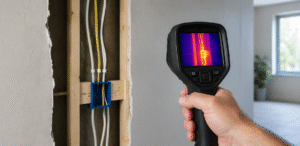
Thermal imaging (infrared thermography) is increasingly recognised by Australian insurers and WHS regulators as a best-practice component of electrical safety audits for factories. When incorporated into the audit, it must comply with AS ISO 18434-1:2023, Condition monitoring and diagnostics of machines, Thermography.
A thermal scan should be conducted on all switchboards, distribution boards, motor control centres (MCCs), and high-current connections under load (ideally at ≥40% of rated load). Our thermal imaging services provide AS ISO 18434-1:2023 compliant inspections with full severity-classified reports, an output that satisfies both insurer requirements and WHS due diligence records.
| ✓ | Checklist Item | Reference |
|---|---|---|
| ☐ | Thermal imaging survey of all switchboards and DBs conducted within the last 12 months by an AINDT Level II certified thermographer | AS ISO 18434-1:2023; insurer requirements |
| ☐ | Thermal report includes severity classification (ΔT thresholds) and recommended action timeframes | AS ISO 18434-1:2023 cl. 7 |
| ☐ | Any ‘Critical’ or ‘High’ severity thermal findings have been remediated and re-scanned | AS ISO 18434-1:2023; WHS Act 2011 duty to eliminate/minimise risk |
| ☐ | Thermal imaging has been conducted at appropriate load (≥40% of rated load), load conditions documented in report | AS ISO 18434-1:2023 cl. 6.4 |
| ☐ | Thermal inspection of motor control centres and VSD panels included in scope | AS ISO 18434-1:2023 |
13. Audit Completion, Remediation & Record-Keeping
An electrical safety audit is only as valuable as the action taken on its findings. The following steps are essential post-audit.
| ✓ | Checklist Item | Reference |
|---|---|---|
| ☐ | All findings are documented with: location, description, photo reference, risk rating, and applicable standard | WHS Act 2011 cl. 38 (risk management duty) |
| ☐ | Critical findings (immediate risk) have been isolated or made safe before auditors leave site | WHS Act 2011 s. 19 (primary duty of care) |
| ☐ | Remediation tasks have been assigned to a licensed electrical worker with target completion dates | WHS Reg 2017 cl. 38 |
| ☐ | Audit report has been signed by the Licensed Electrical Worker who conducted the inspection, including their licence number and state | State electrical licensing legislation |
| ☐ | Copy of audit report is retained on site and in a secure records system for minimum 5 years | WHS Reg 2017; Safe Work Australia guidance |
| ☐ | Follow-up audit or re-inspection date has been scheduled based on findings and risk profile | AS/NZS 3017:2022; WHS Act 2011 duty to review controls |
| ☐ | Audit findings have been communicated to relevant workers and HSR (Health and Safety Representative) | WHS Act 2011 cl. 47–49 (consultation duties) |
For a comprehensive post-audit program, combine your electrical audit with electrical safety inspections and our energy optimisation services to address both safety and efficiency gaps identified during the audit.
14. How Often Should a Factory Electrical Safety Audit Be Conducted?
There is no single mandated audit frequency under Australian law, the WHS Act requires that risks be managed so far as is reasonably practicable, and the appropriate audit frequency depends on the factory’s risk profile. The following guidance is consistent with industry practice and Safe Work Australia recommendations:
- Full comprehensive audit: Annually for most factories; every 6 months for high-risk environments (chemical plants, food processing with water wash-down, foundries)
- Switchboard thermal imaging: Annually minimum; every 6 months for high-load or high-criticality installations
- RCD testing (push-button): Every 6 months per WHS Regulation 2017 cl. 157
- Test and tag (portable equipment): Every 6 months for hostile environments per AS/NZS 3760:2022
- Emergency lighting 6-month test: Every 6 months per AS 2293.1:2018
- Emergency lighting annual duration test: Annually per AS 2293.1:2018
- Earth electrode resistance testing: Every 3 years or after major fault/lightning strike
- Ex equipment inspection (if applicable): Periodically per AS/NZS 60079.17:2017, typically annually for Zone 1/21 equipment
- After any significant electrical work: Verification per AS/NZS 3017:2022 before re-energisation
Frequently Asked Questions
Does a factory electrical safety audit need to be conducted by a licensed electrician in Australia?
Yes. Any physical inspection, testing, or measurement of electrical installations and equipment (including RCD testing, earth resistance testing, and insulation resistance testing) must be performed by a Licensed Electrical Worker (LEW) as required under each state and territory’s electrical safety legislation. The audit report should be signed by the LEW with their licence number and state.
What is the difference between an electrical safety audit and a test and tag?
Test and tag (per AS/NZS 3760:2022) covers only portable and plug-in electrical equipment. An electrical safety audit is much broader, it covers the fixed installation (switchboards, wiring, earthing, RCDs), fixed plant and machinery, hazardous areas, emergency systems, PPE, and safe work procedures. Both are required for full factory compliance.
Is a thermal imaging survey mandatory for Australian factories?
Thermal imaging is not explicitly mandated by name in Australian WHS legislation, but it is strongly implied by the duty to manage electrical risks under the WHS Act 2011 and WHS Regulation 2017. Many commercial and industrial insurers now require it as a condition of cover. Our thermal imaging services provide compliant AS ISO 18434-1:2023 inspections.
What Australian Standard applies to test and tag in factories?
AS/NZS 3760:2022, In-service safety inspection and testing of electrical equipment, is the applicable standard. The 2022 edition is the current version, replacing AS/NZS 3760:2010. Factories are classified as ‘hostile environments’, which means shorter testing intervals (6 months for Class I portable equipment).
What records must we keep after a factory electrical safety audit?
Under the WHS Regulation 2017 and Safe Work Australia guidance, you should retain: the full audit report (signed by the LEW), all test results (insulation resistance, earth continuity, RCD test results), test and tag registers, thermal imaging reports, and emergency lighting test logbooks. Retain records for a minimum of 5 years.
Get Your Factory Audit-Ready
An electrical safety audit is not a one-time tick-box exercise, it is the foundation of an ongoing electrical risk management program. Factories that audit regularly, remediate promptly, and keep proper records are the ones that avoid fires, prosecution, and insurance disputes.
If you are due for an audit, or if you have never had a formal one, the team at ASJ Electrical Solutions provides complete factory electrical safety audits, thermal imaging surveys, and remediation by licensed electrical workers. We operate across Australia and produce reports that satisfy WHS, insurance, and AS/NZS 3000:2018 requirements.
Ready to book a factory electrical safety audit?
Talk to our licensed team → View our electrical safety inspection services