

If you manage commercial property in Australia, you already know the hardest part of electrical maintenance is rarely finding the faults. It is getting the owner to approve the money to fix them. You can walk a site, spot the ageing switchboard, hear the contractor say the installation needs attention, and still hit a wall the moment a five-figure quote lands in front of the owner.
The reason is simple. “The electrician said it needs doing” is not a business case. A properly structured electrical defect report is. This article explains the legal framework that makes defect documentation essential under Australian law, what a compliant report should contain, and a practical framework for using one to turn a maintenance request into an approved work order.
1. The Legal Framework: Why Defect Reports Are Not Optional Paperwork
Electrical safety in Australia is governed by a combination of state electrical safety legislation, the model Work Health and Safety (WHS) laws, and Australian Standards. For property and facility managers, the obligations are more direct, and more personal, than many realise.
The PCBU duty of care
In Queensland, the Electrical Safety Act 2002 (Qld) places the primary duty of care on the person conducting a business or undertaking, known as a PCBU. The duty is to ensure electrical safety so far as is reasonably practicable. Where both the Work Health and Safety Act 2011 and the Electrical Safety Act apply, the Electrical Safety Act takes priority in Queensland. Other states and territories impose comparable duties through their own electrical safety and WHS frameworks.
Three features of this framework matter enormously for property managers:
- Duties are not transferable. Appointing a contractor or managing agent does not discharge the owner’s duty, and it does not remove yours.
- More than one person can hold a duty at the same time. The owner, the managing agent and the person in control of the electrical equipment can all hold concurrent duties over the same installation.
- Officers have their own due diligence obligations. Officers of a PCBU must exercise due diligence to ensure the business has appropriate processes for receiving information about hazards and risks, and for responding to that information in a timely way.
Key point: Once a defect has been identified, you are on notice. Failing to find a fault and failing to act on a documented one are treated very differently by regulators and courts. A defect report creates accountability, but it also creates protection: if you identified the issue, documented it, briefed the owner and recommended remediation, the paper trail proves you discharged your duty.
Penalties and consequences
The Electrical Safety Act 2002 (Qld) sets out a three-tier offence structure for breaches of an electrical safety duty. Category 1 covers reckless conduct that exposes a person to a risk of death or serious injury and carries the most severe penalties, including potential imprisonment for individuals. Categories 2 and 3 cover failures to comply with a duty, with penalties scaling according to the risk exposure involved.
Beyond regulatory exposure, electrical faults remain one of the leading causes of building fires in Australia. Fire and Rescue NSW data has attributed around 40% of residential fires to electrical faults and appliances, and the same failure mechanisms, loose connections, degraded wiring, overloaded circuits, exist in commercial buildings at greater scale and load.
2. What a Proper Electrical Defect Report Contains
Not every document titled “defect report” earns the name. A photo dump with a one-line summary, or a quote with vague references to “various switchboard issues,” gives an owner nothing to make a decision with. A report built for decision-making contains the following components.
| Component | What it should include | Why it matters for owner approval |
|---|---|---|
| Plain language fault descriptions | Each defect described in terms a non-electrician can understand, with the location identified precisely. | Owners cannot approve what they cannot understand. Jargon hides risk instead of communicating it. |
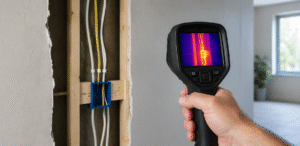
| Photographic and thermal evidence | A photo of every defect, plus thermal imagery where heat-related faults are involved. | A thermal image of a glowing connection does more persuasive work than three pages of text. |
| Risk rating for every defect | Each fault classified as immediate, short-term or programmed. | Priorities turn a list of problems into a decision framework. This is the core of the owner briefing. |
| Recommended remediation actions | A clear description of the work required to rectify each defect. | Lets owners see exactly what they are paying for, and lets contractors quote against a defined scope. |
| Compliance references | The relevant standard or legislative requirement each defect breaches or engages. | Connects the defect to the owner’s legal obligations rather than a contractor’s opinion. |
Reports of this kind are typically produced following an electrical safety inspection, a thermal imaging survey under AS ISO 18434-1:2023, a switchboard assessment, or a periodic verification of the installation. They can also be commissioned independently after works carried out by another contractor, to provide a third-party record of what was found.
3. Risk Ratings Explained: Immediate, Short-Term and Programmed
The risk rating system is the single most powerful tool a property manager has in an owner briefing, so it is worth understanding what the categories actually mean in practice.
| Rating | What it means | Typical action window | Example defects |
|---|---|---|---|
| Immediate | A defect presenting a present danger to people or property. Risk of electric shock, fire or equipment failure. | Rectify now. In some cases, isolate the circuit or equipment until repaired. | Exposed live conductors, severely overheated connections, damaged switchboard with compromised protection. |
| Short-term | A defect that is deteriorating or non-compliant and will become dangerous if left unaddressed. | Typically within 1 to 6 months. | Connections showing elevated temperature rise, ageing RCDs failing trip-time tests, overloaded circuits. |
| Programmed | A defect or non-conformance suitable for planned rectification within a maintenance budget cycle. | Typically 6 to 24 months, scheduled. | Obsolete switchgear with no spare capacity, labelling non-conformances, ageing but serviceable wiring. |
Key point: Risk ratings are what allow you to stage spend. Owners who reject a single $40,000 request will routinely approve a $9,000 immediate package now and a planned program for the remainder. The rating system gives you a defensible basis for that staging.
4. How to Brief an Owner Using a Defect Report: A Four-Step Framework
Step 1: Lead with the risk summary, not the total cost
Open the briefing with the breakdown: “The inspection identified 11 defects. Two are rated immediate, four short-term, five programmed.” This frames the conversation around risk before money enters it. An owner who hears “two immediate safety risks” first responds very differently from one who hears the total figure first.
Step 2: Separate the must-do from the should-do
Do not bundle immediate items with programmed works and force an all-or-nothing decision. Immediate defects get approved quickly because the report makes the liability obvious. Secure those approvals first, then present the short-term and programmed items as a planned maintenance budget across the next 6 to 24 months.
Step 3: Translate defects into business consequences
Owners think in dollars, downtime and liability. For each significant defect, connect the fault to its consequence: unplanned outage, tenant disruption, insurance complications, or regulator attention following a notifiable incident. Under Queensland’s Electrical Safety Regulation, serious electrical incidents and dangerous electrical events must be notified to the regulator, which means a preventable failure can quickly become a documented compliance matter. A defect report lets you make these points credibly, because every claim traces back to a photographed, risk-rated finding from an independent inspection.
Step 4: Close with the protection argument
The report itself is part of the value. Remind the owner that a documented inspection, briefing and remediation plan is exactly the evidence trail that demonstrates the duty of care was discharged. For owners, that is insurance against the worst-case scenario. For you as the manager, it is professional protection in writing.
5. Using the Report to Engage Contractors and Verify Works
Once works are approved, the same report becomes your scope of works. Contractors quote against specific, described, photographed defects rather than interpreting a vague request. The practical benefits:
- Quotes are comparable, because every contractor is pricing the same defined scope.
- Variations drop, because the scope was defined by an independent inspection rather than discovered mid-job.
- Completion can be verified defect by defect, with a clean record of what was fixed against what was found.
Some property managers also commission an independent defect report after another contractor’s works are completed. This provides third-party verification that the remediation was actually carried out to standard, which is particularly valuable for strata committees and councils that must demonstrate due diligence in their asset management records.
6. Covering the Assets You Cannot See From the Ground: Drone and Aerial Inspection
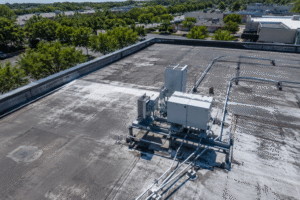
A common blind spot in defect reporting is rooftop and elevated infrastructure. Rooftop solar arrays, switchroom roofs, high warehouse ceilings and large-format roofing are costly and disruptive to inspect by traditional means. Scaffolding, elevated work platforms and roof access permits add cost, delay and working-at-height risk, so in practice these assets often simply go uninspected. Defects up there never make it into a report, which means they are never briefed, budgeted or fixed.
This is where a drone and aerial inspection earns its place in the defect reporting process. A combined thermal and visual drone and aerial inspection can cover rooftop solar, plant rooms and hard-to-access areas in a fraction of the time, identifying hotspots, panel degradation, moisture ingress and physical damage from above. The findings feed directly into the same defect report structure: georeferenced imagery, fault locations, risk ratings and recommended actions.
Compliance note: Commercial drone operations in Australia must comply with the Civil Aviation Safety Authority’s Part 101 requirements. Always confirm your provider operates licensed, CASA-compliant flights, and that thermal findings are interpreted by personnel who understand electrical installations, not just drone operation.
For property managers running multi-site portfolios, the practical outcome is a complete picture: one inspection cycle, one consistent reporting format, every asset documented, including the ones nobody has physically looked at in years.
7. Building the Ongoing Compliance Trail
A single defect report is a snapshot. The full value comes from making it part of a documented cycle:
- Inspect on a defined schedule appropriate to the installation’s age, environment and criticality, including in-service safety inspection and testing of electrical equipment under AS/NZS 3760:2022 where applicable.
- Document every finding in a structured defect report with risk ratings and photographic evidence.
- Brief the owner using the framework above, and keep a record of the briefing and the owner’s decisions.
- Remediate approved works against the defined scope, and verify completion against the original report.
- Retain the full chain of records in your asset management system. This is the evidence trail that demonstrates electrical safety duties were discharged so far as reasonably practicable.
Councils in particular benefit from this cycle, because documented defect records integrate directly into asset management systems and support both audit requirements and forward capital works planning.
Frequently Asked Questions
Is an electrical defect report a legal requirement in Australia?
There is no single law that says “you must obtain a defect report.” However, the duty to ensure electrical safety so far as is reasonably practicable under legislation such as the Electrical Safety Act 2002 (Qld), and the officer’s duty to have processes for receiving and responding to information about hazards, make documented identification of electrical defects the practical mechanism for demonstrating compliance. In an incident investigation, the absence of any inspection and defect records is very difficult to defend.
Who is responsible for fixing defects: the owner or the property manager?
Both can hold duties at the same time. Under Australian electrical safety and WHS frameworks, duties are not transferable, and more than one person can owe a duty over the same installation. The owner generally funds and authorises works, while the manager’s role is to identify, escalate and document. A defect report with a recorded owner briefing is how a property manager evidences that their part of the duty was discharged.
How often should a commercial property have an electrical inspection and defect report?
It depends on the installation’s age, condition, environment and use. Many commercial sites adopt an annual thermal imaging survey of switchboards alongside periodic verification of the installation, with in-service testing of equipment under AS/NZS 3760:2022 at intervals determined by the environment. Older installations, harsh environments and critical facilities warrant shorter cycles. An initial inspection and defect report establishes the baseline from which a sensible schedule can be set.
What is the difference between a defect report and a contractor’s quote?
A quote is a price for work the contractor proposes to do. A defect report is an independent record of what was found, how serious it is and what should be done about it. The report comes first and defines the scope; quotes are then obtained against it. Combining the two in one document from one party removes the independence that makes the report persuasive to owners.
Can drone inspections replace physical electrical inspections?
No. A drone and aerial inspection complements ground-level inspection by covering rooftop and hard-to-access assets that would otherwise go unexamined. Switchboard internals, equipment testing and verification work still require a licensed electrical worker on site. The two approaches together produce the complete defect picture.
The Bottom Line
A defect report is not paperwork. It is the bridge between “the site has problems” and “the owner approved the budget.” It protects you legally by documenting that known risks were identified and escalated, and it protects you professionally by making every funding request specific, evidenced and prioritised.
If your current inspection outputs are a wall of jargon, an unprioritised fault list, or a verbal “there’s a few things that need doing,” you are working harder than you need to and carrying more risk than you should.
Get Defect Reports Built for Decision-Making
At ASJ Electrical Solutions, we produce structured electrical defect reports designed for exactly this purpose: briefing owners, engaging contractors and satisfying compliance records. Every report includes plain language fault descriptions with photos, priority ratings across immediate, short-term and programmed categories, and recommended remediation actions for each defect.
We also offer CASA-compliant drone and aerial inspection services for rooftop solar, large facilities and hard-to-access infrastructure, so nothing on your site goes undocumented.
Manage commercial property, council facilities or a multi-site portfolio in Queensland?
Request a defect report or drone inspection quote from ASJ Electrical Solutions