
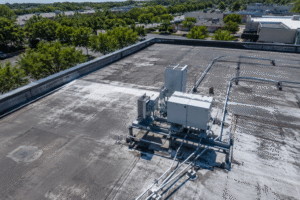
Commercial rooftops are where some of the most valuable and most neglected assets on a property sit. Solar arrays, HVAC plant, switchroom roofs, cable trays, skylights and large-format roofing all live up there, and most of them have one thing in common: nobody has physically looked at them in years.
The reason is practical, not negligent. Traditional roof access means scaffolding, elevated work platforms, permits, harness systems and working-at-height risk, so inspections get deferred until something fails. A drone and aerial inspection removes that barrier. A licensed operator can capture high-resolution visual and thermal imagery of an entire commercial roof in hours, without anyone leaving the ground.
The harder question is timing: how do you know when your rooftop actually needs one? Here are the five signs that matter, grounded in Australian conditions, standards and compliance obligations.
1. Your Rooftop Solar Output Has Dropped, Or You Simply Do Not Know
Australia now has more than 28 GW of rooftop solar installed nationally, and Queensland leads the country with over 1.1 million installations according to Clean Energy Council reporting. For commercial sites, a rooftop array is a revenue-producing asset, and like any asset, it degrades.
The faults that erode solar output rarely announce themselves from the ground:
- Hotspots and failed bypass diodes. Individual cells or panel sections running hot, visible only as thermal signatures on the panel surface.
- Cell cracking and delamination. Often caused by hail, thermal cycling or installation stress, and frequently invisible to the naked eye.
- String and connection faults. A single failed string can quietly remove a measurable share of system output for months before anyone interrogates the monitoring data.
- Soiling and shading patterns. Dust, bird fouling and debris accumulation that monitoring software registers only as a vague decline.
Key point: Aerial thermography of PV arrays is an established methodology under IEC 62446-3, which is used as guidance for thermographic inspection of solar installations in Australia. A drone thermal scan under solar irradiance can identify hot cells, failed diodes and underperforming strings across an entire commercial array in a single flight. If you cannot say with confidence what your array produced last quarter versus its commissioning baseline, that is itself the sign.
2. The Site Has Been Through a Storm, Hail or Extreme Weather Event
Queensland’s storm season delivers hail, destructive winds and intense rainfall to commercial rooftops every year. The damage that matters is often not the damage you can see from the carpark:
- Hail fractures in solar panels that leave the glass intact but crack cells beneath, degrading output and creating future hotspot risk.
- Lifted or displaced roof sheeting and flashings that open water entry paths into ceiling spaces and electrical infrastructure.
- Water ponding that accelerates corrosion and loads the structure beyond design intent.
- Debris impact damage to rooftop plant, cable trays and conduit runs.
After a significant weather event, an aerial inspection serves two purposes at once. It identifies damage requiring rectification before water and corrosion compound it, and it produces date-stamped, georeferenced imagery that supports insurance claims. Insurers respond to documented evidence; a thermal and visual record captured shortly after the event is precisely that.
3. Nobody Has Physically Inspected the Roof Since Handover
This is the most common sign of all, and the most quietly dangerous. Under the model Work Health and Safety Regulations, a PCBU must manage the risk of falls from height, and Safe Work Australia’s Code of Practice on managing the risk of falls makes clear that the first control is avoiding the need to work at height where reasonably practicable. Falls remain one of the leading causes of traumatic worker fatalities in Australia.
The honest consequence on most commercial sites is that roof inspections are deferred indefinitely. Access costs money, creates risk and disrupts operations, so the roof gets inspected when it leaks. By then, the defect list is longer and the repair bill larger.
Key point: A drone and aerial inspection inverts this equation. It satisfies the hierarchy of controls by eliminating the work-at-height risk entirely for the inspection task, costs a fraction of scaffold or EWP access, and produces a more complete photographic record than a walk-over typically does. If the roof has not been formally inspected in more than two years, or you cannot locate the last inspection record, you are overdue.
| Access method | Typical setup | Inspection coverage | Work-at-height risk |
|---|---|---|---|
| Scaffolding | Days to erect, permits, significant cost | Limited to scaffold zones | Present for erectors and inspectors |
| Elevated work platform (EWP) | Hire, licensed operator, ground access required | Edges and reachable zones only | Present, plus plant operation risk |
| Rope access | Specialist crews, anchor points required | Good, but slow across large roofs | Present, specialist controls required |
| Drone aerial inspection | Hours, CASA-licensed operator, no roof contact | Entire roof, including no-go zones | Eliminated for the inspection task |
4. You Can See Warning Signs From the Ground
By the time a rooftop problem is visible from ground level, it has usually been developing for some time. Treat any of the following as a trigger for a closer look from above:
- Rust staining or corrosion streaks running down walls or visible at roof edges.
- Sagging gutters, displaced flashings or visibly lifted sheeting after wind events.
- Internal ceiling stains, damp patches or mould in top-floor tenancies.
- Vegetation growth in gutters or on the roof surface, indicating blocked drainage.
- Unexplained increases in energy use from rooftop HVAC plant working against degraded housings or failed insulation.
An aerial inspection converts these ground-level suspicions into a documented defect picture: where the water is entering, how far corrosion has progressed, which sections of roofing or plant need attention now versus later. That documentation is what turns a hunch into an approved repair budget.
5. You Are Preparing for a Transaction, Insurance Renewal or Compliance Audit
The fifth sign is not a defect at all. It is a deadline. Rooftop condition becomes commercially significant at predictable moments:
- Sale or purchase due diligence. Rooftop plant, solar arrays and roofing condition materially affect asset value, and an aerial inspection report gives both sides an evidence base.
- Insurance renewal. Insurers increasingly ask for condition evidence on large roofs and rooftop solar. A current inspection report supports premium negotiations and prevents disputes about pre-existing damage.
- Compliance and asset audits. Councils and corporate portfolios need documented condition records in their asset management systems. Under electrical safety legislation such as the Electrical Safety Act 2002 (Qld), the duty to ensure electrical safety so far as is reasonably practicable extends to rooftop electrical assets, and documented inspection is how that duty is evidenced.
The findings from an aerial inspection feed directly into a structured electrical defect report with risk ratings across immediate, short-term and programmed categories, which is the format owners, insurers and auditors can actually act on.
What a Professional Drone and Aerial Inspection Involves
Not all drone services are equal, and for commercial electrical and rooftop work the details matter:
- CASA compliance. Commercial drone operations in Australia must comply with the Civil Aviation Safety Authority’s Part 101 requirements. Confirm your provider operates licensed, compliant flights with appropriate approvals for the site’s airspace.
- Thermal and visual capture together. High-resolution visual imagery identifies physical damage; radiometric thermal imagery identifies electrical hotspots, moisture ingress and PV faults. You want both in one flight.
- Qualified interpretation. Thermal images of electrical assets should be interpreted by personnel who understand electrical installations, with thermographic methodology consistent with AS ISO 18434-1:2023 for electrical plant and IEC 62446-3 guidance for PV arrays.
- Georeferenced, risk-rated reporting. The deliverable should not be a folder of photos. It should be a structured report with fault locations, severity ratings and recommended actions that slots into your maintenance planning.
Frequently Asked Questions
How often should a commercial rooftop have an aerial inspection?
As a general rule, annually for sites with rooftop solar or significant rooftop plant, and after any major storm or hail event. Sites in coastal or corrosive environments, older buildings and critical facilities warrant shorter cycles. The first inspection establishes a baseline; subsequent inspections track deterioration against it.
Can a drone inspection detect leaks in a commercial roof?
Often, yes. Moisture trapped beneath roofing membranes and insulation retains heat differently from dry material, which produces detectable thermal patterns under the right conditions, typically after sunset as the roof cools. Thermal aerial imagery is a recognised technique for mapping suspected moisture ingress across large roofs, with confirmed areas then verified by targeted physical testing.
Do drone inspections work for rooftop solar under warranty?
Yes, and this is one of the strongest use cases. Thermal signatures of cell defects, failed bypass diodes and delamination provide documented evidence for manufacturer warranty claims. IEC 62446-3 aligned thermographic reports are widely accepted as supporting evidence for PV warranty and performance disputes.
Is a drone inspection a legal requirement in Australia?
No law mandates drone inspections specifically. However, PCBUs hold duties to manage risks from rooftop electrical assets and to manage the risk of falls when arranging inspections. An aerial inspection is frequently the most reasonably practicable way to discharge both: the asset gets inspected and documented, and nobody works at height to achieve it.
What does an aerial inspection cost compared to traditional access?
Costs vary by site size and complexity, but the comparison is rarely close. Scaffolding or EWP access for a large commercial roof can run into thousands of dollars before an inspector steps onto it, plus permits and disruption. A drone inspection typically completes the same coverage, or better, in hours at a fraction of the cost, which is why many sites move from reactive to scheduled inspections once they switch.
The Bottom Line
Commercial rooftops fail quietly. Solar output erodes, water finds its way in, corrosion compounds, and the first formal notice anyone takes is a leak, an outage or an insurance dispute. The five signs above, declining or unknown solar performance, recent severe weather, no inspection history, ground-level warning signs, and an approaching commercial deadline, are the practical triggers for getting eyes on the roof before the roof forces the issue.
A drone and aerial inspection makes that decision easy: complete coverage, no work-at-height risk, and a documented, risk-rated record that supports maintenance budgets, insurance claims and compliance obligations alike.
Book an Aerial Inspection Built for Commercial Sites
At ASJ Electrical Solutions, our CASA-compliant drone and aerial inspection service combines high-resolution visual capture with radiometric thermal imaging, interpreted by a team that understands electrical installations, not just flight operations. Findings are delivered as a georeferenced, risk-rated report that feeds directly into your defect reporting and maintenance planning.
Manage a commercial facility, rooftop solar array or multi-site portfolio in Queensland?
Request a drone inspection quote from ASJ Electrical Solutions